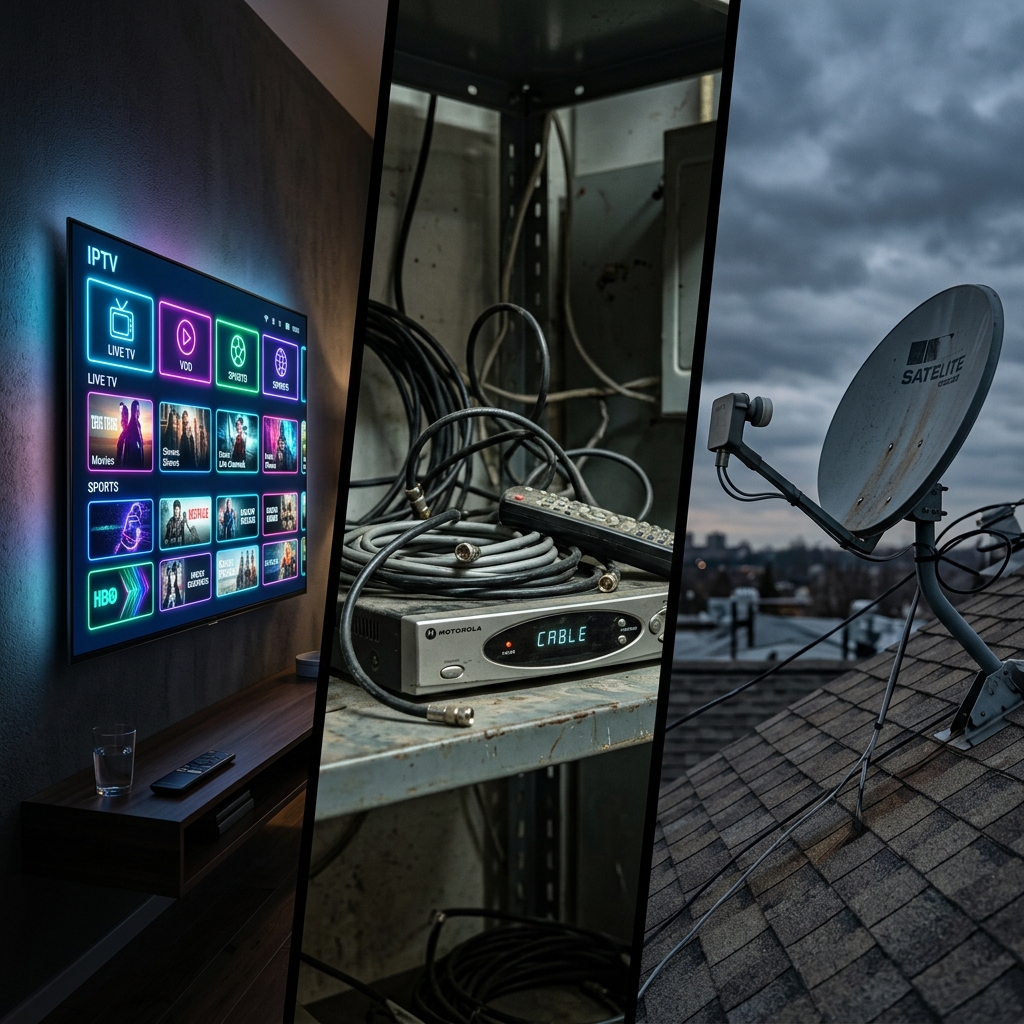
The television landscape has changed more in the last three years than in the previous three decades. Cable subscribers are abandoning their contracts at record pace, satellite dishes are disappearing from rooftops, and IPTV has quietly grown into a 250-million-subscriber global industry. If you're still paying a cable or satellite bill in 2026 — or you're weighing up your options for the first time — this guide gives you a complete, honest comparison across every factor that actually matters.
No fluff. Just the real differences between three very different ways to watch TV.
💡 New to IPTV? If you want to understand how it works before diving into the comparison, our complete beginner's guide to IPTV is the right place to start.
How Each Technology Works
Understanding what's happening behind the screen explains everything else in this comparison.
Cable TV sends channels through a physical coaxial or fiber-optic cable that runs from your provider's local hub directly into your home. All channels are broadcast simultaneously along the cable at all times — your set-top box simply tunes to whichever frequency corresponds to the channel you want. Everything depends on the physical infrastructure your provider has built in your neighborhood.
Satellite TV transmits signals from broadcasting satellites orbiting Earth to a dish installed on your roof or external wall. The dish receives the signal and passes it to a receiver box inside your home. Signal quality is excellent in clear weather but vulnerable to heavy rain, strong winds, and obstructions. Professional installation is required, and apartment dwellers often have no access at all.
IPTV delivers live TV channels, video-on-demand, and catch-up content over your existing broadband internet connection — the same connection you use for everything else. No additional physical infrastructure. No dish. No cable engineer. The signal travels through your router to any internet-connected device in your home or anywhere in the world.
For a deep technical breakdown of how IPTV infrastructure works under the hood, Wikipedia's IPTV overview covers the protocol and delivery architecture clearly.
Round 1: Cost 💰
This is where the comparison becomes stark.
Cable bills in the US averaged around $120 per month in 2026 before add-ons — and that number rises significantly once you factor in sports tiers, premium channels, DVR fees, and mandatory equipment rental. A fully loaded cable package covering sports, international content, and 4K easily pushes past $160–$200 per month. Most providers lock customers into 12–24 month contracts with early termination fees running into the hundreds of dollars. Annual rate hikes are standard practice.
Satellite packages typically run $60–$120 per month for mid-range plans, plus equipment rental costs. Like cable, sports and premium content carry surcharges. Installation fees apply, and the hardware itself (receiver, dish) costs money to maintain or replace. Satellite contracts often run 24 months.
IPTV subscriptions typically land between $10 and $30 per month with no contracts, no installation fees, and no equipment rental. Most providers include all channels, sports, 4K, and VOD in a single flat price. Annual plans reduce the effective monthly cost further — often bringing it below $10 per month.
The arithmetic is impossible to ignore. Households switching from cable to IPTV typically save $800 to $1,500 per year. Over five years, that's enough to buy every device in your home several times over.
| Category | Cable | Satellite | IPTV |
|---|---|---|---|
| Monthly cost (base) | $83–$127 | $60–$120 | $10–$30 |
| Sports add-on | +$25–$45 | +$20–$40 | Included |
| 4K access | +$10–$20 (extra box) | Limited | Included |
| Installation | $50–$100 one-time | $100–$200 | None |
| Contract | 12–24 months | 12–24 months | None |
| Annual total (est.) | $1,500–$2,400 | $960–$1,800 | $120–$360 |
🏆 Winner: IPTV — by a very wide margin.
📹 For a video breakdown of the real cost differences in 2026, watch Is Streaming Still Cheaper Than Cable in 2026? (YouTube) which covers the full price picture including hidden fees most providers don't advertise upfront.
Round 2: Channel Selection 📺
Cable packages typically include between 200 and 500 channels depending on your tier. In practice, the channels most people actually want — premium sports networks, international content, pay-per-view events — are almost always locked behind additional tiers that cost more. Base packages are priced low specifically to draw you in, then upsell you. International content is a particular weakness: if you want Arabic news, Spanish sports, Indian cricket, or French entertainment on cable, the options are extremely limited or non-existent in most Western markets.
Satellite offers broadly similar channel counts to cable, with some geographic advantages — certain satellite packages carry more international feeds by design. DirecTV's NFL Sunday Ticket was historically a satellite-exclusive, though streaming rights have since migrated online. Weather-related signal loss remains a real limitation.
IPTV operates on an entirely different scale. Quality IPTV providers offer between 10,000 and 25,000+ live channels covering the US, UK, Canada, Europe, the Middle East, Asia, Latin America, and more — all in one package, at one price. International sports, foreign language channels, niche content, local news from other countries — all included without add-ons. Sports blackout restrictions that frustrate cable subscribers don't apply.
⚽ For sports fans specifically, our article on why sports fans are choosing IPTV in 2026 goes deeper into what IPTV offers across NFL, NBA, soccer, UFC, and more — and how it compares to cable's fragmented sports packages.
🏆 Winner: IPTV — 30–100x more channels at the same or lower price.
Round 3: Picture Quality 🔍
Cable delivers HD content at 1080i on most channels — interlaced, which is slightly less sharp than progressive 1080p streaming. True 4K is available on cable, but only through premium add-on packages from select providers, and requires a 4K-capable set-top box that typically carries an additional monthly rental fee.
Satellite provides solid picture quality under good weather conditions, generally comparable to cable. 4K satellite broadcasts exist but are limited to specific packages and require compatible hardware.
IPTV quality scales with your internet connection. At 15 Mbps you get stable HD. At 25+ Mbps you get Full HD 1080p. At 50+ Mbps you're streaming 4K HDR. The best IPTV providers in 2026 deliver native 4K with HDR support included in standard plans — no extra box, no extra fee. Our guide on best IPTV apps for Smart TV covers which players handle 4K and HDR best on different devices.
You can check whether your connection can handle 4K streaming with Ookla's free Speedtest tool before committing to a plan.
🏆 Winner: IPTV — 4K included as standard, not as an expensive add-on.
Round 4: Device Flexibility 📱
Cable ties you to the room where a set-top box is installed. Watching in another room requires another box — and usually another monthly rental fee. Watching outside your home requires a separate app from your provider, if they offer one at all, and it typically doesn't include everything from your cable package.
Satellite carries similar limitations. You stream on the TV connected to the receiver. Some providers offer companion apps for mobile viewing, but content restrictions and geographic limitations apply.
IPTV works on every screen you own — Smart TV in the living room, Firestick in the bedroom, phone on the commute, laptop at a hotel, tablet in the garden — all on the same subscription. Our device-specific setup guides cover every option:
- 🔥 Firestick → complete Firestick setup guide
- 🤖 Android Box & Smart TV → Android Box & Smart TV guide
- 📺 Roku & Apple TV → Roku & Apple TV setup guide
- 🍏 iPhone & iPad → iPhone & iPad IPTV guide
For guidance on how many screens you can run simultaneously, our IPTV multi-device guide covers everything about connection plans and simultaneous streaming.
🏆 Winner: IPTV — watch on anything, anywhere, on any screen.
Round 5: Installation & Setup ⚙️
Cable requires a technician visit to connect the physical cable to your home, install the set-top box, and configure the service. This involves booking an appointment, being home during a multi-hour window, and paying a one-time installation fee. Equipment failures also mean scheduling engineer visits.
Satellite requires professional installation of the dish — a significant project involving drilling, mounting, alignment, and wiring. In apartments, this is often not permitted at all. Storms or even heavy rain can knock out your signal, sometimes requiring realignment or equipment replacement.
IPTV requires no installation whatsoever. You subscribe online, download an app on whatever device you already own, enter your credentials, and start watching — often within five minutes of signing up. Our beginner's guide walks through the full process if you want step-by-step guidance.
🏆 Winner: IPTV — zero installation required.
Round 6: Reliability ⚡
Cable is generally reliable, with service dependent on the physical infrastructure in your area. Outages are relatively rare but can affect entire neighborhoods when they occur. Equipment failures require waiting for an engineer visit.
Satellite is reliable in clear conditions but genuinely vulnerable to weather. Heavy rain, thick cloud cover, and high winds can all degrade or cut the signal entirely — exactly when you're most likely to want to be watching TV indoors. Dish realignment after storms is a documented ongoing maintenance issue.
IPTV reliability in 2026 has improved dramatically, with the best providers offering 99.9% uptime guarantees. The one genuine limitation is your internet connection: during a broadband outage, IPTV goes down along with everything else on your network. For households with reliable broadband above 25 Mbps, this is rarely a practical concern. If buffering is ever an issue, our IPTV buffering fix guide and internet optimization guide cover every solution.
🏆 Winner: Cable (marginally) — the only edge it retains. Satellite loses on weather vulnerability.
Round 7: Contracts & Flexibility 📋
Cable and satellite both typically require 12–24 month contracts with early termination fees that can run $150–$400. Annual price increases are standard — and you have no ability to negotiate mid-contract.
IPTV providers offer month-to-month subscriptions with no contracts and no penalties for cancelling. Switching services, upgrading your plan, or pausing a subscription is entirely under your control. Annual plans offer the best per-month pricing, but with many providers these are still cancellation-free.
Our guide on how to choose the right IPTV plan covers what to look for in a subscription structure before you commit.
🏆 Winner: IPTV — no contracts, full flexibility.
The Tipping Point: May 2025
A milestone worth noting: in May 2025, streaming television surpassed traditional cable for the first time in US viewing history. Major US cable providers collectively shed millions of subscribers in 2025 alone, continuing a decade-long decline. Meanwhile IPTV subscriber numbers globally reached a quarter billion — a number that would have seemed implausible just five years ago.
📹 For the context behind these numbers, check out How Streaming Services Are Outpacing Cable and Satellite (YouTube) which covers the Nielsen data and industry trends driving the shift. And for an honest on-the-ground test of different IPTV service types, I Tested Every IPTV Type So You Don't Waste Money (YouTube) is a practical 2026 review worth watching before you choose a provider.
Who Should Still Choose Cable or Satellite?
To be fair: cable and satellite still make sense for a specific minority of users.
Cable is still worth considering if:
- 🏢 You live in a building where cable infrastructure is already installed and included in your rent
- 📶 Your internet connection is unreliable or below 15 Mbps
- 🛋️ You want a completely hands-off, no-setup experience
Satellite is still worth considering if:
- 🌲 You live in a rural area without reliable broadband coverage
- 🚐 You travel in an RV or boat and need TV access in locations without broadband
- 🏟️ You specifically need satellite-exclusive sports packages unavailable elsewhere
For everyone else — the vast majority of urban and suburban households with a stable broadband connection — the choice in 2026 is straightforward.
📹 For a side-by-side video comparison of cable and satellite specifically, Cable TV vs Satellite TV: Which Is Best for You? (YouTube) covers their respective strengths honestly before you rule either out. And for a complete breakdown of how IPTV and satellite compare head to head, IPTV vs Satellite TV: Which One Is Better for You? (YouTube) is a thorough and balanced independent review.
Final Scorecard
| Category | Cable | Satellite | IPTV |
|---|---|---|---|
| Monthly Cost | ❌ | ⚠️ | ✅ |
| Channel Count | ⚠️ | ⚠️ | ✅ |
| 4K Quality | ⚠️ | ⚠️ | ✅ |
| Device Flexibility | ❌ | ❌ | ✅ |
| Setup Ease | ❌ | ❌ | ✅ |
| Reliability | ✅ | ⚠️ | ✅ |
| No Contract | ❌ | ❌ | ✅ |
| International Content | ❌ | ⚠️ | ✅ |
| Overall Winner | 🏆 IPTV |
The Verdict
IPTV wins in 2026 — and it's not particularly close. For most households with a reliable internet connection, IPTV offers more channels, better flexibility, equal or superior picture quality, zero installation hassle, and savings of $800–$1,500 per year compared to cable. The only meaningful advantage cable retains is reliability during internet outages — a scenario that affects a small minority of users.
If you're ready to make the switch, our top IPTV service recommendations for 2026 will help you choose the right provider. For a full price breakdown of what you'd actually save by switching from cable or satellite, our IPTV vs Netflix vs Cable cost comparison puts all the numbers side by side in one place.
